|
|
|
|
|
|
|
|
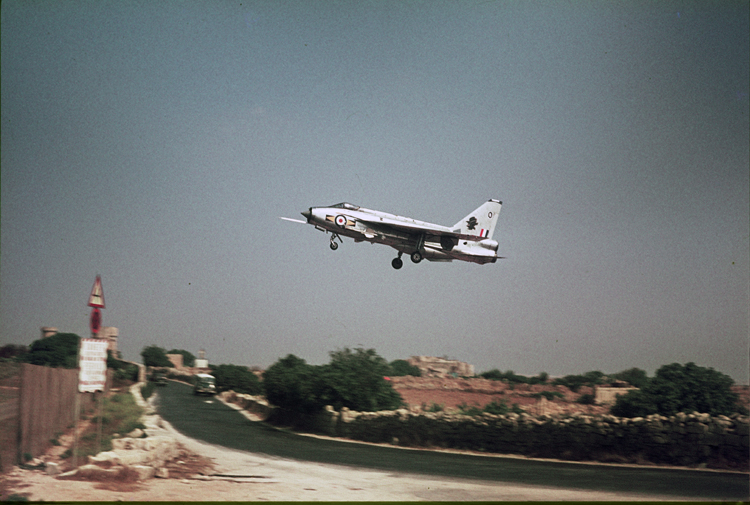
An unidentified 11 squadron Lightning F.3 (left) on short finals to runway 24 in this undated photograph by Charles Caruana. The road layout remained the same until at least early 1979, after which a traffic island was added where the road splits (lower left, not seen in photo) to go either into Luqa village, or continue onto the old terminal. The low rubble wall running just outside the perimeter fence starting underneath the sign (lower right) has since been eliminated, allowing the road to be widened.
|
| |
|
|
|
|
In the beginning
Luqa Airport's beginning dates back to the turbulent days of the Second World War. In 1939 the RAF felt that the seaplane base at Kalafrana, and the other two small airfields at Hal-Far and Ta' Qali, should have a supplementary airfield which would overcome all the bad weather problems that the other three suffered from. Thus it was designed from the start as an all-weather aerodrome.
The site chosen, at a height of 250ft above sea level, one and a half miles inland from Grand Harbour, was very hilly and contained many quarries from where the Maltese cut stone for building. Work started early in 1935, consisting at first of levelling the whole area. Luqa was to become Malta's first tarmac airfield. In actual fact, the new aerodrome boasted three main runways, all surfaced with tarmac and a fourth one which was left unsurfaced until 1941.
The four runways were:
NE-SW 06/24 1200 yards x 850 yards x 50 yards tarmac strip
NW-SE 32/14 1200 yards x 850 yards x 50 yards tarmac strip
N-S 36/18 1100 yards x 800 yards x 5O yards tarmac strip *
E-W 09/27 1100 yards x 850 yards x 50 yards tarmac strip **
By the end of April 1941 the NE-SW runway was extended to 1400 yards, while the NW-SE runway, which was extended to 1400 yards by December 1940, was further extended to 1740 yards by April 1941. Luqa airfield, destined as a base for RAF bombers, went into operation on 1st April 1940, although in June 1939 Flt. Lt. George Burges had made the first landing at this new airfield in a Swordfish aircraft.
In July 1940 a small Station Headquarters was established at the angle formed by the runways NE-SW and NW-SE, consisting of six Bellman hangars, barracks, offices, and a petrol store at back. The SE part of the airfield served as the bomb dump, while machine-gun posts were sited along the perimeter. A month later, in August 1940, Luqa became an independent station with a Wing Commander as its Station Commander. A few months later the RAF appointed a Group Captain Station Cdr., due to the recognised importance of Luqa. So much so that, by December 1940, Luqa was already serving as a base for Wellington bombers.
During the war, Luqa Airport played an important part in keeping away German and Italian aircraft and ships from approaching Malta. Several aircraft squadrons operated from Luqa to the extent that by November 1942 personnel at the station numbered 4350 (comprising among others 770 Army personnel and 600 civilians, including Maltese). Luqa was able to handle 24 Wellingtons by 1941.
The year 1943 saw Luqa as a base for reconnaissance and anti-submarine patrol aircraft. In 1943, RAF Luqa was decommissioned as an operational airfield and served the RAF solely as a major staging post. But it wasn't to remain long in this role because, in April 1948, No.38 Squadron arrived on the station with its Lancasters.
After the war Luqa airfield settled down once again as a reconnaissance base, employing Meteors, Lancasters, and Shackletons. In 1956, due to the Suez Canal crisis, RAF Luqa was once again extremely busy due to its involvement in Operation Musketeer. Valiant and Canberra bombers operated against targets in the Egyptian Canal Zone.
|
| |
|
|
|
|
This page is basically divided into two parts. The first part consists of a description of Luqa Airport, whilst the second part is a description of what could be seen in the late sixties and seventies by a Maltese enthusiast.
|
| |
|
|
|
|
The British withdrawal
On 21 September 1964, Malta obtained her independence from Great Britain, but signing a ten-year defence agreement with the UK. But after winning the 1971 elections, the Labour Government immediately expelled all NATO and US forces from the island, and asked the British Government to withdraw its forces by 1 January 1972. The deadline was later extended to 15 March and then 31 March of the same year. Although negotiations were constantly being held, the Ministry of Defence initiated Operation Exit, the pull out of all service personnel out of Malta. No. 13 Squadron re-located to RAF Akrotiri, and No. 203, by now re-equipped with the Nimrod MR.1, took up station at NAS Sigonella in nearby Sicily. On 20 March, a Nimrod made a low pass over Luqa as the RAF Ensign was lowered for what was then thought to be the last time. However, a few days later, agreement over the rent money to be paid for the use of facilities in Malta was resolved. A new agreement, which would expire on 31 March 1979, was signed. No. 203 returned between 21-29 April supported by no less than 25 Hercules and 19 Belfast sorties. No. 13 returned later in October.
Updating the airport
Back in 1969, plans had started being drawn up on how to improve Luqa Airport, the more so since a new breed of wide-body airliners, like the B.747, were entering service, necessitating longer runways. Part of these plans called for the extension of a runway, and in May 1972, the Maltese Government started work on the extension of runway 14-32 (NW-SE). An Italian engineer, Sig. Mario Marra, took charge of the whole project, which got underway in May 1972 and took five years to complete.
Extended from 1781 yards to 3833 yards, the runway was inaugurated on 1 October 1977. The very first aircraft to land on it was an Air Malta Boeing 720B, AP-AMJ, when, in the late afternoon of 27th September 1977, it took off and made several touch-and-goes on the new runway. The first wide-body aircraft to land was an Alitalia DC-10, l-DYNL, on the inauguration day. The first Boeing 747 to use runway 14-32 was EI-ASI of Aer Lingus on October 22, 1977.
Luqa was decommissioned as a RAF station on 29th September 1978, for which a special programme was held. The RAF's aerobatic team, the Red Arrows, the last time they would be seen with the Gnat, together with a number of other RAF front line aircraft like the Harrier and Jaguar, gave a spectacular display in front of a very large crowd. Air Chief Marshal, Sir David Evans KCB, CEB, RAF, was the reviewing officer.
The runway
Runway 14-32, extended from 1781 yards to 3833 yards, was inaugurated on 1 October 1977. In this aerial view of the airfield, the threshold of runway 32 is at the upper right. Going along to the runway, i.e. to the left, the large apron (roughly in the middle of the photo) is Park 9. Further left can be seen a smaller apron, this being Park 8. Also visible is the Air Malta hangar. Below the hangar, and slightly to the left, is what appears to be a large circle. That is the compass bay, an area free from any magnetic fields, to enable an aircraft’s compass to be properly calibrated. Immediately below the compass bay is the threshold of runway 14. (A cockpit view of the approach to runway 14 can be seen here.)
If you go to bottom right, you’ll see the threshold of runway 06. The darker part of the runway signifies the part that was extended during the fifties. To the left of the 06 threshold is the northern taxiway, and if you move along this, that large whitish area is park 4, where the majority of airshow participants are placed on static display. Further along the taxiway, and to the left, is park 3, and above that is a large concrete area with two hangars. This is park 2, and a better view of this park can be seen in this photo. (The large hangar, middle right belongs to Lufthansa Technic, see under New terminal.) Interesting to note that there is actually a taxi-way from Park 3 to Park 2. This is because before the extension of 14/32, the threshold of 14 was very close to the fence.
Going back to the northern taxiway, just before turning left into Park 3, there is rectangular grey area, situated between the taxiway and runway 24/06, and is also directly below the compass bay. This used to form part of the old east-west runway mentioned earlier. Above this grey area, and at right angles to it, you can see what appears to be a road, starting from Park 2, and cutting across the northern taxi-way, and runway 24/06. This is what remains of the old north-south runway.
Civil Aviation
Although in those days Luqa had a total of eight parks for aircraft, only No. 8, with six parking bays, was dedicated solely to civil operations. (A ninth Park was added with the extension of runway 32/14.) The arrivals and departure lounges led directly onto this park, and an open-air viewing balcony, situated above and between bays 2 & 3, provided excellent facilities for aircraft photography, either when taxiing within the park -- especially between bays 1 and 4, or when using runway 14.
However, a foreign airline, soon after it started operating to Malta in the eighties, complained that this balcony was a security threat, and in 1985, the Government installed window panes.
In 1973, the Air Malta Company was set up, and shortly afterwards, a hanger was built for its aircraft on Park 8 towards bay 6. After the British departure, Air Malta also took over a hangar previously used by the RAF overlooking park 2.
In 1978, another aviation company began operations from Malta, this being Mediterranean Aviation, or Med-Avia.
That same year also saw the handing over of Hal-Far airfield to the Maltese Government, which affected two different bodies. The International Air Rally of Malta, which had been using Hal-Far since 1969, started using Luqa Airport as their venue.
Far more serious were the consequences for the Malta International Aviation Company, (MIACO), who were ordered to vacate their premises by September 1978. Finding an alternative site on an island measuring 17 miles by 9 would prove to be a bit problematic. The problem was eventually solved by moving into a hangar and buildings outside the village of Safi, previously used as a Maintenance Unit (MU) by the RAF. The site itself is located just outside the perimeter of runway 32/14. A gate was installed in the perimeter fence of Luqa Airport, and a taxiway leading from the runway to this gate was also constructed. For aircraft to enter or depart, airport security had to open the gate, and along with MIACO personnel, psychically stop traffic whilst an aircraft entered or departed company premises. Although MIACO went into voluntary liquidation in February 1985, the site is now used by two different companies, Med-Avia and NCA Int. In the late nineties, a traffic lights and barrier system went into operation, thus providing a more orderly and safer means of traffic control during aircraft entry/departures.
Another company that is involved in aircraft maintenance started operations as from 1 January 2003, when a new joint venture between Air Malta and Lufthansa Technik of Hamburg came into being. Lufthansa Technik (Malta) performs checks on B.737 and A.320 type aircraft. Apart from Lufthansa, other clients so far have included Spaniar and Travel Service.
After the departure of the British Armed Forces in 1979, Luqa Airport saw the AFM's Helicopter Flight (since re-named Air Squadron), move to Park 7, previously the residence of the RAF’s No. 13 Squadron.
The Flight, at the time equipped with four Bell 47s and an AB.206, had been based at St. Patricks since its inception in 1972, and had made a brief sojourn to Hal-Far airfield prior to the British departure. It has since remained at Luqa, and an additional hangar has also been built.
General Aviation
This class of aviation has seen the highest registration of aircraft in Malta, and in fact, at the time of writing (August 2006) there are a total of 30 light/microlight aircraft – but excluding biz-jets/commuters – representing 52.63% of aircraft currently carrying the 9H prefix. One of the complaints by GA aircraft owners was the lack of hangar space, exposing the aircraft to the elements. For this reason, over the last two years, three different hangars have been constructed at Parks 1, 3 and behind the control tower. The last houses a number of micro-lights of the Island Microlight Club.
Air traffic Control
Before we continue, a word about the air traffic control operations.
In preparation for the expected British withdrawal in March 1972, it was planned to bring Egyptian personnel to take over the running of ATC facilities. Most probably, the 11th hour agreement with the British Government made such plans redundant.
By the sixties, it became apparent that the control tower, situated between parks 1 and 2 was now two small for Luqa's requirements. Probably coupled with the Maltese government decision to widen and expand runway 14/32, a new control tower was built on the opposite side of park 8. Work started in 1971, and cost the British Government £Stg1.25 million. The tower was inaugurated on 24 September 1974.
Another "mini" control tower was built on Park 9, to ensure better safety and control of aircraft movements. It handles all aircraft movements within the park.
Personnel
After the British departure in March 1979, controllers were given the option of either forming part of the ATC Corps of the Armed Forces of Malta or to leave – the purpose for forcing controllers to become part of a military unit being to eliminate the chances of a strike. Several left to continue with their careers abroad. The relationship between the AFM and the ATC Corps was never a happy one, and there were many occasions when ATC personnel were threatened with a court martial. Morale was always low and investment in new equipment, or training, was minimal.
This situation continued until 28 February 1995, when all ATC staff stopped working to show their disapproval at the Government-proposed reorganisation of the ATC. The situation lasted for around 35 hours, during which the Malta Flight Information Region (FIR) was closed. A number of flights, for humanitarian reasons, were permitted to depart or land in Malta. Most of the problems were resolved after ATS representatives had talks with the Prime Minister, Dr Fenech Adami, but their primary request, to become part a civilian unit, was not met. In the Budget speech of 1997, Dr. Sant, the Prime Minister of the day, announced that the ATC was to be demilitarised.
The ATC Corps ceased to exist on 30 April 1998, and on 1 May became the ATS Division of MIA (Malta International Airport) plc, which was a change for the better. No only was the staff freed from the threat of military discipline but working conditions improved. The right to strike, however, is still denied, as they provide what falls under the classification of an essential service.
New Radar
In the meantime a new radar system, replacing the old Plessey AR1 approach radar at Luqa, complete with modern ancillary services, had been installed, and the ATS staff started working earnestly on this new system. It also resulted in a number of Italian Air Force PD.808s coming to Malta, to assist in the radar’s calibration. A new Area Control Centre had been built and operations transferred to the new ACC, which was inaugurated on 27 April 2001.
In 2001 a second radar was bought to replace the Secondary element of the Dingli enroute-radar. Works on this site started in April 2002. Not only was the secondary element replaced but also its Primary antenna was dismantled and refurbished. Both Secondary radars are Alenia Monopulse Secondary Surveillance Radars with a range of about 220 nautical miles and covering up to 50000 feet. This type provides extremely accurate position information due to the unique construction of the radar antenna. The old Selenia Primary Surveillance Radar at Dingli has a range of around 150 nm while the Luqa primary radar has only 60nm range to cover operations in the vicinity of Malta.
On 1 January 2002, MIA plc ceased to be the Air Traffic Service provider. Its functions have now been taken over by a dedicated company, the Malta Air Traffic Services Co. Ltd. Besides taking over all obligations and duties previously carried out by the ATS Division of MIA, MATS is actively involved in several international ATC projects. A group of ATS staff forms part of the project teams, conducting research and studies in future Communication, Navigation, Surveillance and Air Traffic Management (CNS/ATM) strategies. In addition, earlier in 2002 year, 2 Maltese controllers spent nearly 8 weeks in Rome, forming part of an international ATS team conducting radar simulations on these CNS/ATM projects.
New Terminal
Another development was the construction of a new civil terminal overlooking Park 9. The old terminal had been inaugurated on 1 April 1958, by 1991 the old civil terminal at park 8 had been enlarged, anticipated increases in passenger movements dictated the building of a more modern and suitable terminal. This was inaugurated in 1992, and with it came a change in name. Whereas previously, exiting the old terminal brought you to the outskirts of Luqa village, the new terminal touched the outskirts of Gudja *** village. It was therefore decided to refer to the airport as Malta International Airport, rather than Luqa Airport.
Accidents
As with any other airport, Luqa has seen its share of tragedies. Apart from the Second World War, accidents have also occurred in peacetime. First to spring to mind would be the Vulcan (XM645) crash over the village of Zabbar in October 1975, and the crash after take-off of a 13 Squadron Canberra in late 1978.
As for civilian aircraft, the hi-jacking of a KLM B.747 in November 1973 caused a sensation. Not only was it the first such incident, but runway 24/06 wasn’t deemed safe for operations by such wide-bodied aircraft. It is to the crew’s credit that they did so without any damage to the aircraft or property on the ground. After negotiations with the Prime Minister of the day, Mr. Dom Mintoff, the passengers were released, and the aircraft departed Malta.
This episode was followed by a Libyan Arab Airlines F.27, 5A-DDU in October 1979, and a B.727, 5A-DII, also of L.A.A. In both cases, after negotiations, the hi-jackers surrendered, and the passengers released.
But by far the worst was the hi-jacking of a Egyptair B.737 in November 1985. The attempts by Egyptian commandos to storm the aircraft and rescue the passenger resulted in 60 deaths, and the capture of only one of the hi-jackers.
Another incident, which had no casualties, was the Super Constellation, which had the false registration of 5T-TAF. This was impounded in Malta in 1968. After the pilots skipped bail and left Malta, the aircraft was sold in 1973. It was turned into a Bar & Restaurant by its new owners, something of a novelty in those days. Although it had closed for business several years ago, talks were being conducted to acquire it for the Malta Aviation Museum at Ta' Qali. Located a stone’s throw from the Med-Avia/NCA premises at Safi, it was regrettably destroyed in an arson attack in January 1997.
Memorable Moments
Luqa Airport hasn’t only witnessed tragedy. From an enthusiast’s point of view, other memorable occasions in recent times include the holding of a summit between Presidents George Bush (Sr.) and Gorbachov in December 1989, which brought a flurry of US military aircraft activity to Malta. Other aviation highlights would be the setting up of Air Malta, and the large number of aircraft it leased, the number of British-registered Heralds, Viscounts and HS.748’s leased by Tunisavia, (amongst other aircraft types), the seven Zimbabwean-registered Turbo-Trushes in 1988, the number of Caribous seen when NCA first started operations in 1986, the various aircraft seen by foreign heads of state for the Commonwealth Heads of Government Meeting held in November 2005, and of course, the annual airshow.
* As from 1941. This runway is no longer in service.
** This runway is no longer in service.
*** As the Maltese alphabet does not contain the letter Y, the letter J is pronounced as a Y.
The above history of Luqa Airfield first appeared in the Luqa Aviation Yearbook 1983/84, as Luqa Airport – A Brief History. I am grateful to the committee of the Malta Aviation Society (MAS) for granting me permission to reproduce it here. I have also posted additional material that didn’t appear in the original article.
|
| |
|
|
|
|
|